


In between reading the news and whatever social media platforms are doing, I decided to just post about a current shape WIP because it makes more sense for me to do that, then reiterate my constant confusion and anger at the current state of affairs.
Astronomy Photos of the Day has been frozen since October 1st and that just really grinds my gears, because talk about low barrier to entry edeavors. It’s a picture, of something related to astronomy, posted on a site that looks like it could be at home in 1998, and it doesn’t have enough money to post a new picture (and index all the required hyperlinks) because APOD is a nasa.gov site. Things like this make me feel like this:

for all the good that it will do me to rant and rave. I’m pretty good at doing both things, sometimes even in a humorous way, but lately I haven’t been feeling it. There’s this feeling I have that we’re on the cusp of massive amounts of bugs crawling out of the woodworks, so to speak, in the manner of any number of horror films.1 That stuff is supposed to stay in the theatre, and some lunatic has let It out for a frolic.
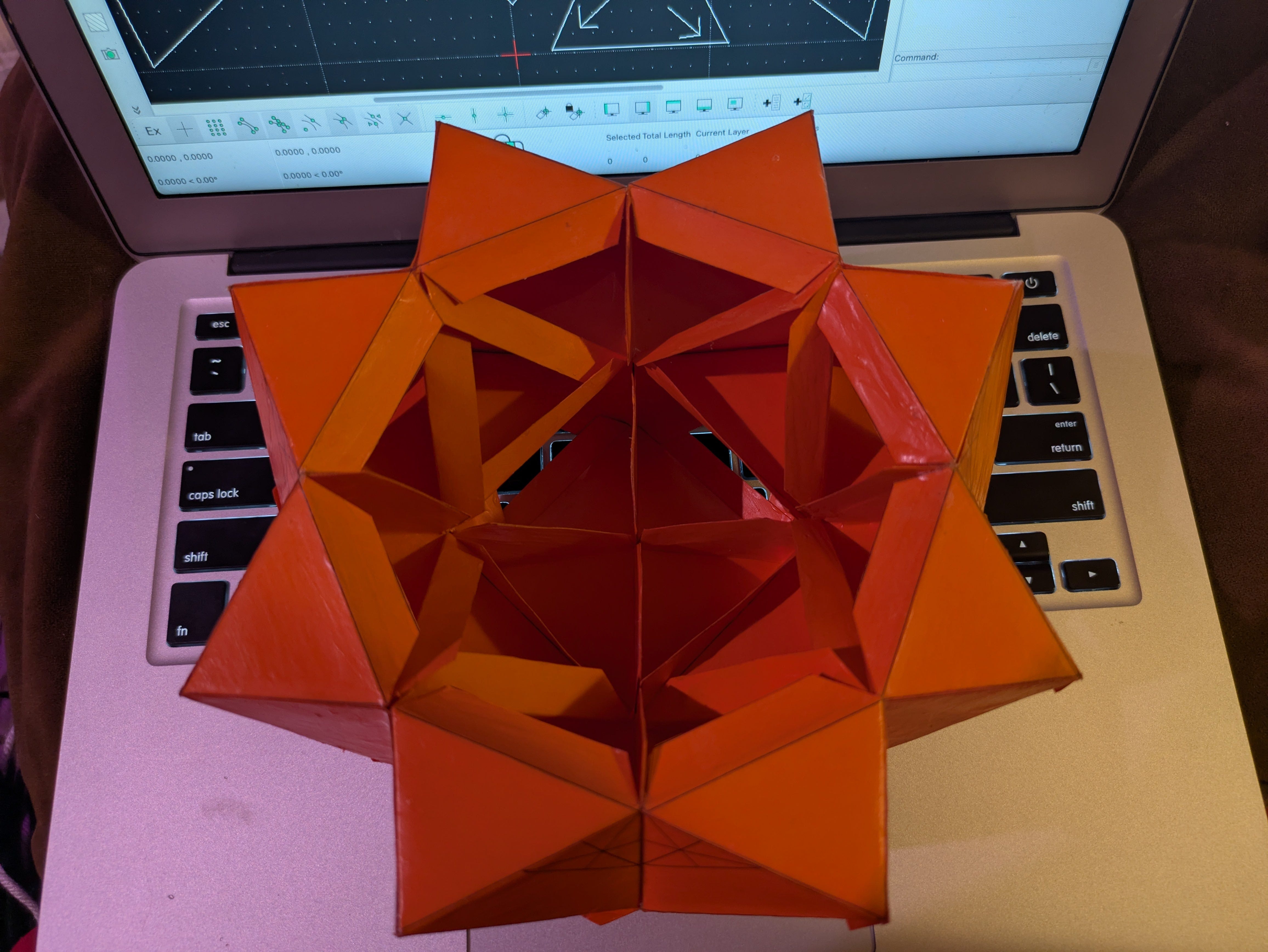
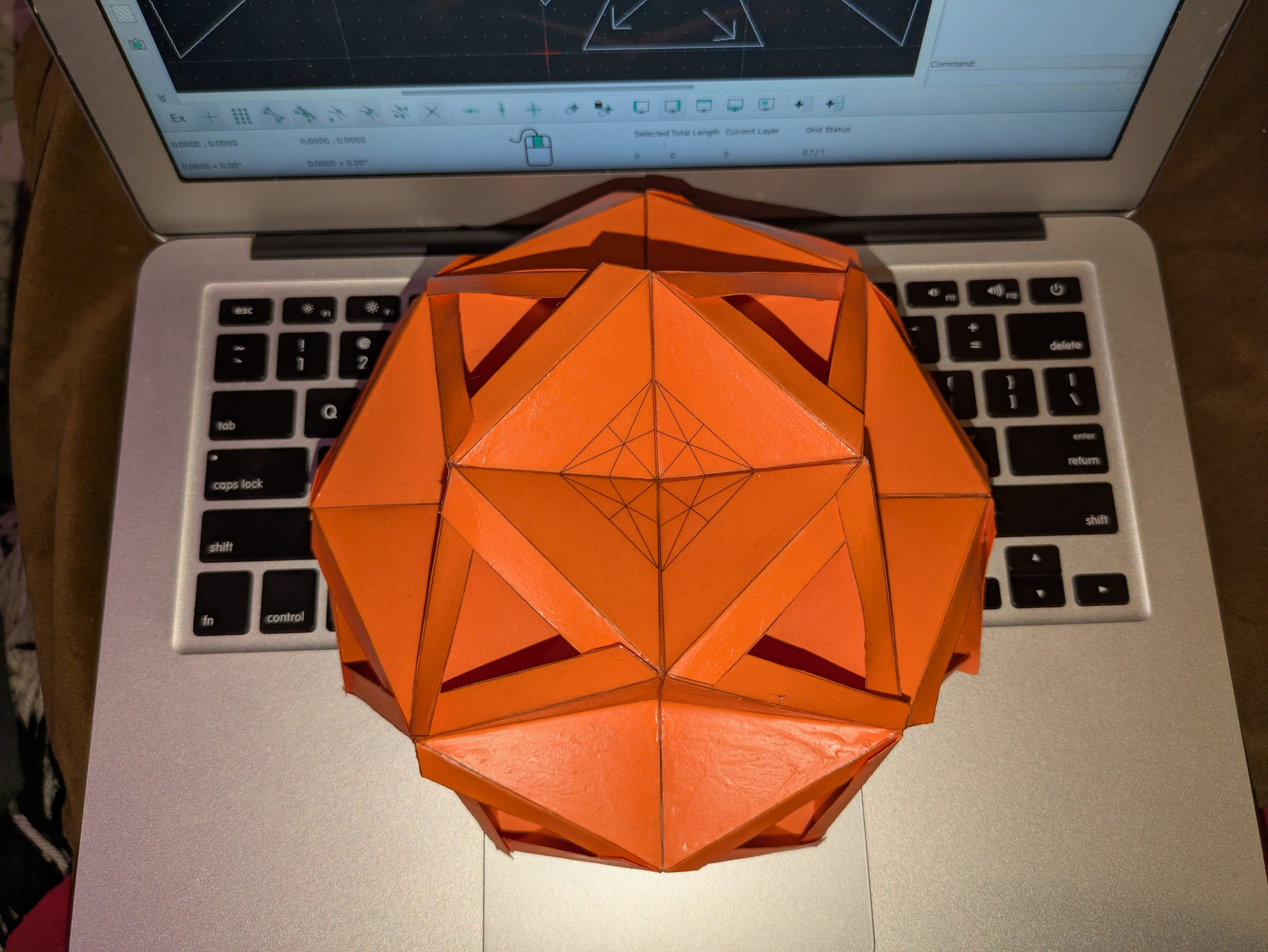
So, shapes. I’m currently exploring a dual shell, octahedron-based, geodesic dome, where the frequency of the inside face is one less the frequency of the outside face. What this means, essentially, is that for twelve of the same, specially-designed octahedrons, you can enclose space dome-style.
Inside, the Star of Inanna. Sits nice and flat:
Top-down, nice symmetry for lining up with compass points:
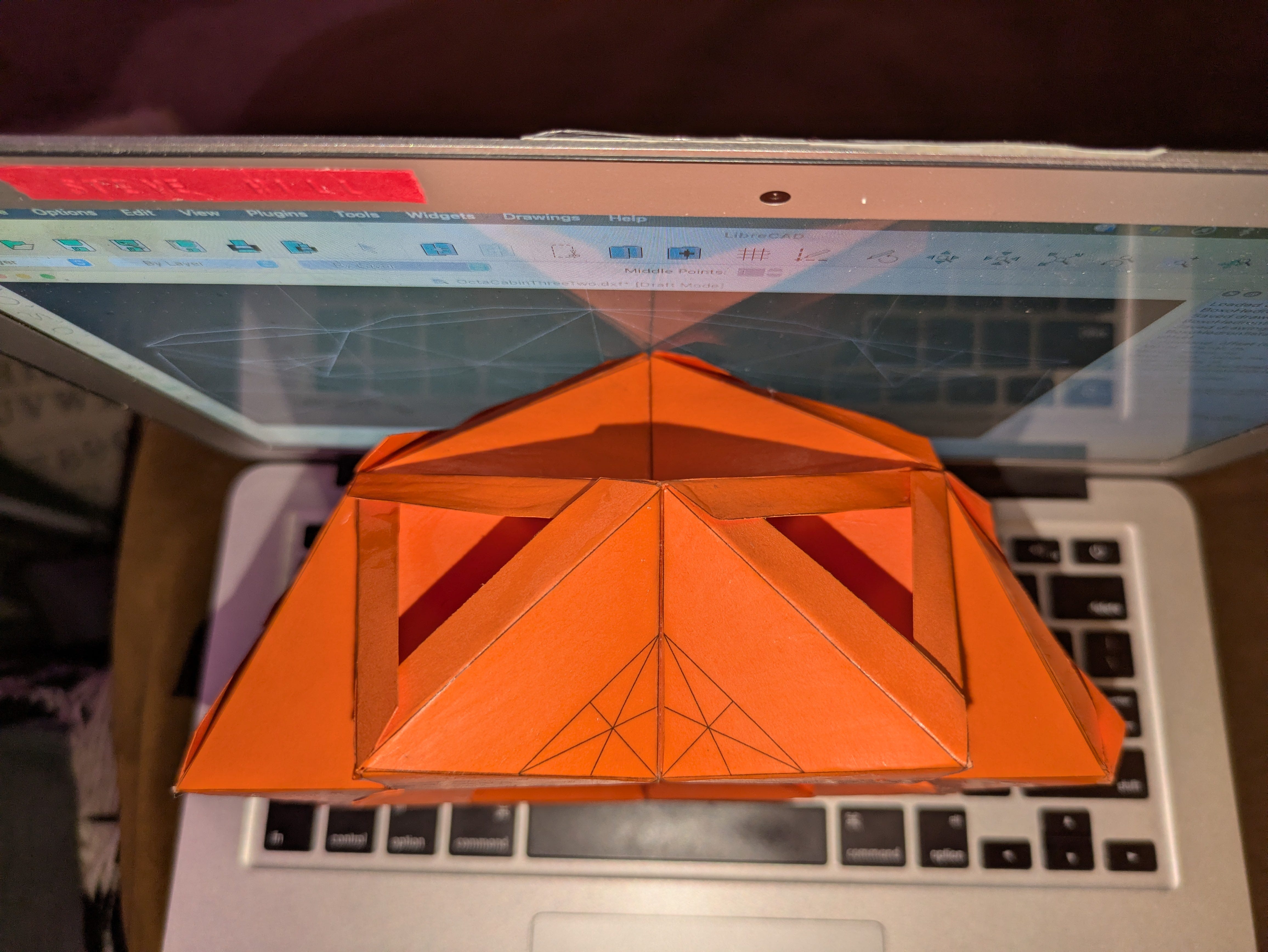
Side profile lends itself to easy-leaning loafers, distributed wind loads, solar gain, et al. The apex being concave would make a nice water collection basin, earth-ship style.
Plenty of visual interest on the inside without making one feel you’re in a beehive:
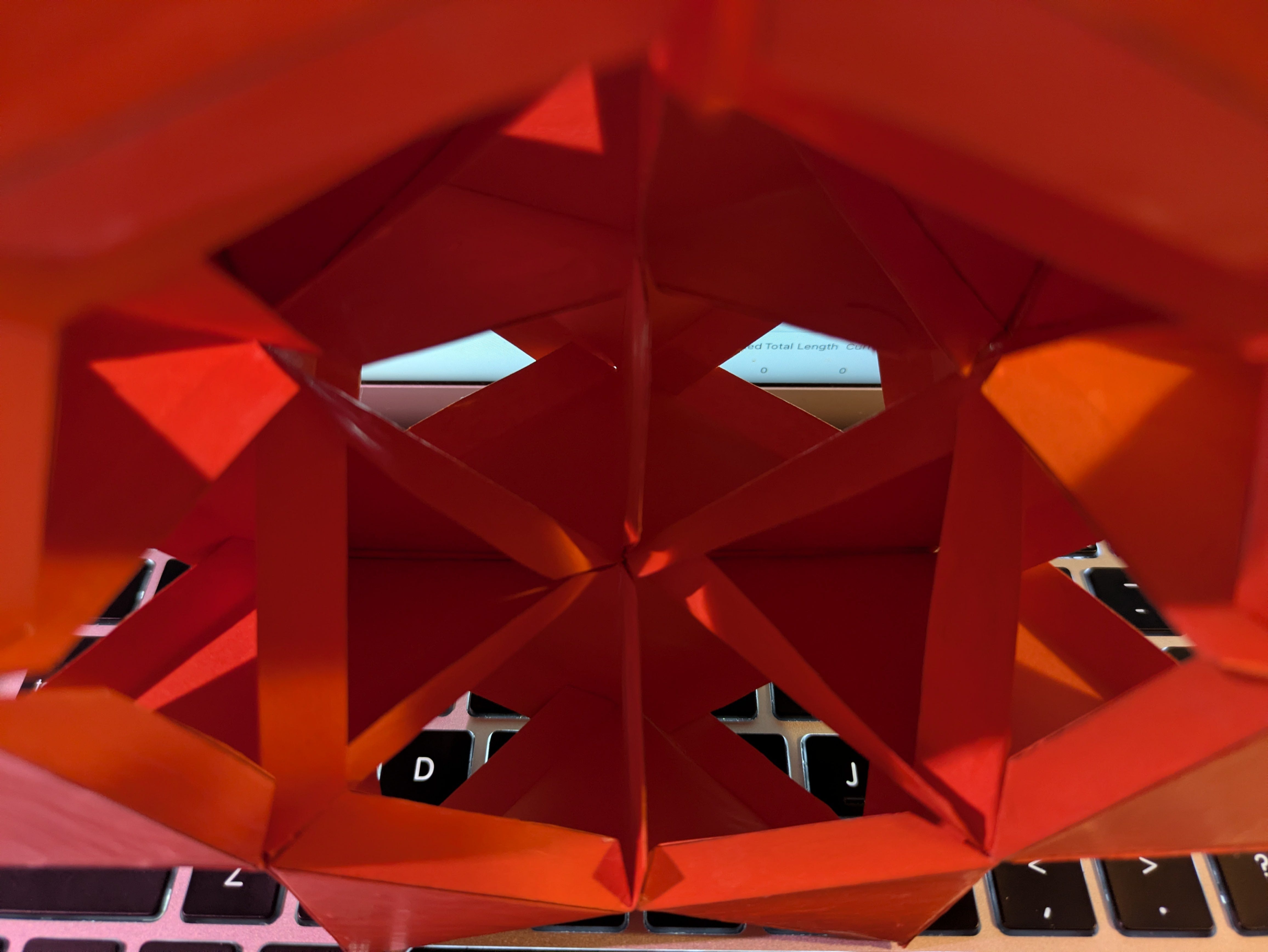
Incorporating the “thickness” of the shell from using octahedrons allows for plenty of dead air space, useful for insulation. That will become more apparent when the structure get’s skinned.
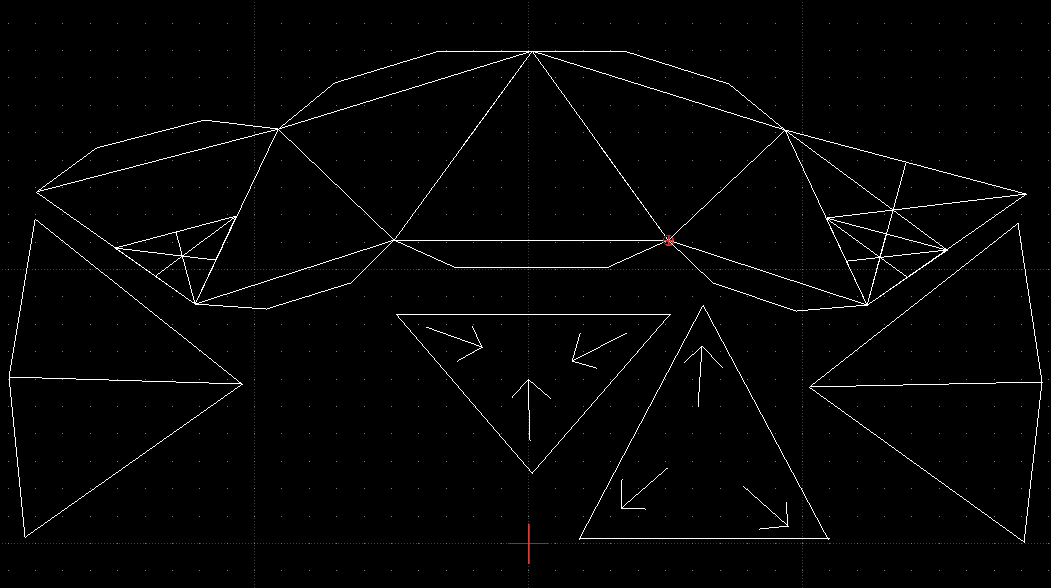
What I especially like about this technique is the volume is developed from a flat sheet, simply folding creases and fastening a”glue tab” makes an octahedron “missing” two faces. No mucking about with hubs and struts. Those faces are your inner and outer windows, respectively. Likely it is thicker than it needs to be; I find thicker shapes to be easier to work with paper-wise. If this was a larger structure made, say, out of sheet metal, those triangles could be much thinner. This has the added advantage of allowing a roll of sheet metal to be stamped out quickly and efficiently on a assembly line, should one so desire (and have access to that kind of capital outlay, of course).
With that bottom ring of eight triangles, it might be useful to elevate the dome upon triangular columns, perhaps four to fit with the theme, and provide a little more volume to work with. This would pair nicely with the earlier examined notion of “any-size” octet trusses. Likely for a a human-sized build the frequencies would need to be increased to 4 inner, 5 outer, simply to keep the size of the triangles down. This would increase the complexity somewhat, but not so far for it to be rocket science. I would like to test this 2-3 with a thinner shell, but will need to make the model substantially bigger so that my blessed glue stick can actually be of some use. These tab connections get a little precarious in a ship-in-a-bottle kind of way. This isn’t a bad test-run, though.
Perfect for Spooky Season!